

What Is a Meeting Room Booking System? Features, Benefits & Uses
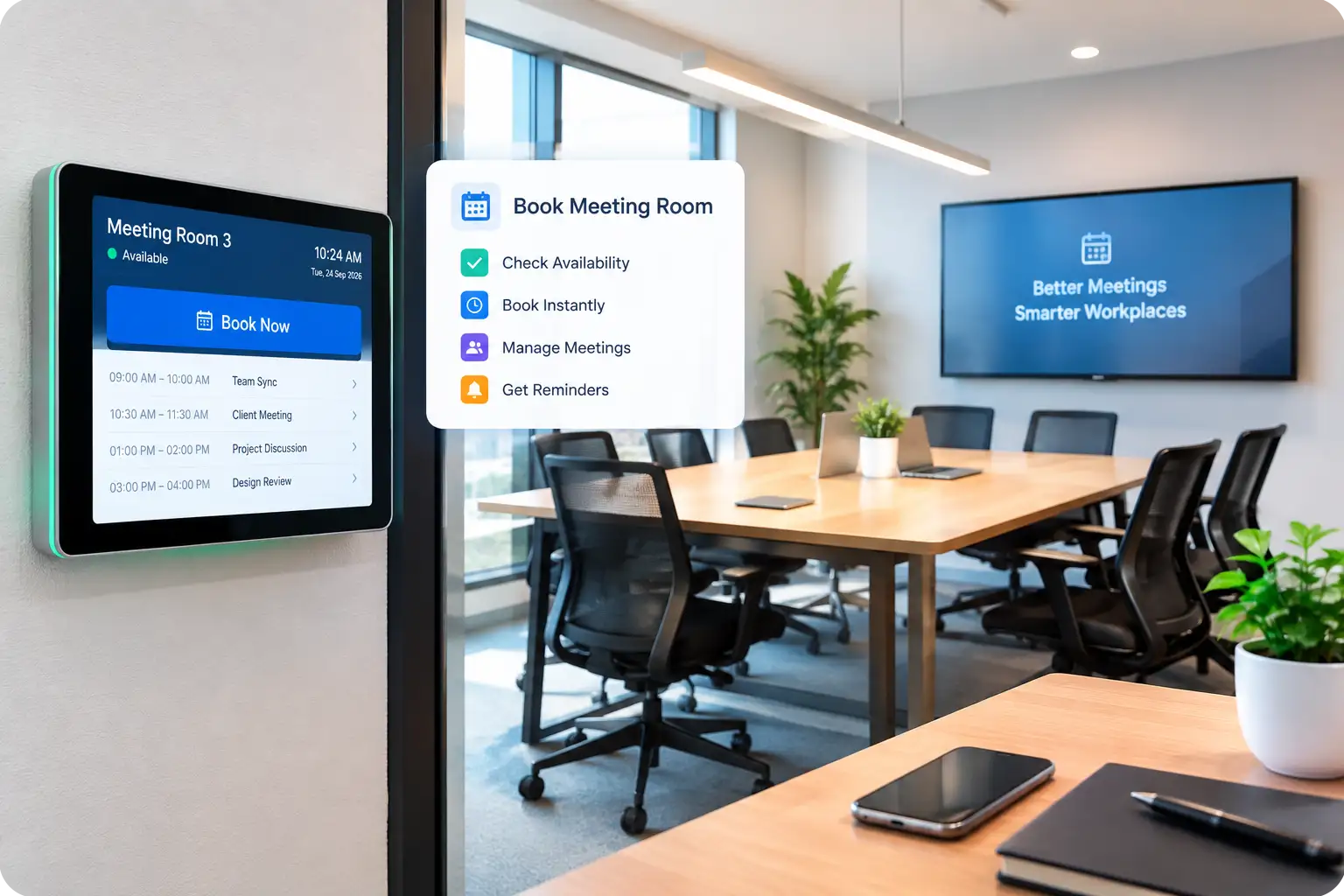
Here is something that happens in most offices at least once a week. A team walks into a meeting room they booked, finds another group already sitting there, and everyone spends the next ten minutes figuring out whose calendar entry was correct. Or a room sits empty for ninety minutes because the meeting was cancelled and nobody updated the booking. Or a senior leader needs a room for an urgent client call and every room on the floor appears occupied — even though three of them are visibly empty.
None of these situations are dramatic. But they happen regularly; they waste time, and they come from the same root cause — managing meeting rooms without a proper system.
According to a workplace utilisation study, the average meeting room is used at only 30-40% of its actual capacity, despite appearing fully booked on scheduling calendars. The gap between booked and actually used space is one of the most consistent and addressable inefficiencies in modern office management.
A Meeting Room Booking System is what closes that gap. This post covers what it is, what it does, who needs it, and what to look for when choosing one.
What Is a Meeting Room Booking System?
A Meeting Room Booking System is a digital platform that handles the booking, scheduling, and real-time tracking of meeting rooms within an office or facility. It gives employees a way to check availability and make reservations — from a phone, desktop, or a display panel outside the room itself — while giving facilities teams the usage data they need to manage space effectively.
At its most basic, a Conference Room Management System replaces the shared spreadsheet or email-based booking process that most offices start with. At a more complete level, it integrates with calendar tools, displays live room status on panels outside each door, automatically releases rooms when nobody shows up, and generates reports on how rooms are actually being used across the week.
A Conference Room Management System serves the same purpose at a larger scale — managing multiple rooms across multiple floors or locations from one centralised dashboard, with each room having its own booking rules, resource configurations, and access settings.
Why Do Offices Need One?
The honest answer is that most offices do not feel the need for Meeting Room Booking Software until the problems it solves become frequent enough to be genuinely disruptive. That point usually arrives when:
- The organisation grows past a certain size and informal coordination — a quick message to a colleague, a shared calendar that everyone checks — stops being reliable.
- Remote and hybrid working creates a gap between who appears to be using a room on the booking system and who is actually using it in person. Research from JLL's 2024 Workplace Report found that organisations running hybrid models see up to 40% of meeting room bookings result in no-shows — rooms that appear occupied but are empty.
- Leadership starts asking about space utilisation — how often rooms are used, whether the office has the right number for the current headcount — and nobody has data to answer with.
- The frustration of double bookings, ghost bookings, and last-minute room hunting reaches a point where it affects how people feel about coming into the office.
A good Office Meeting Room Booking System does not just fix the booking problem. It changes how the organisation understands and manages its physical space.
Key Features of Meeting Room Booking Software
Not all systems have the same feature set. Here is what comprehensive Meeting Room Booking Software should include — based on what organisations across sectors have found most impactful in practice:
Real-Time Availability Display
Every room's availability is visible in real time — on the booking platform, on mobile, and on the display panel outside the room. Employees see current status, the next booking, and when the room becomes free — without walking the floor or asking reception.
In facilities where MLAI Solution has deployed room display panels, reception desk queries about room availability dropped by an average of 60% within the first month of implementation.
Multi-Channel Booking
Employees book from whatever is most convenient — desktop browser, mobile app, calendar integration, or the touch panel at the room door. All booking methods update the same system in real time. A room booked from one channel is immediately unavailable on all others — preventing double bookings at the system level rather than relying on users to check before booking.
Calendar Integration
A meeting room booking software that integrates with Google Calendar and Microsoft Outlook means room bookings appear alongside the rest of the employee's schedule. Book from the calendar and the room is reserved. Book from the room panel and the calendar invite goes out automatically. The two are the same action — not two separate steps.
Room Check-In and Auto-Release
When a meeting starts, the organiser checks in at the room panel. If nobody checks in within a configurable grace period — typically 10 to 15 minutes — the room is automatically released and becomes available to others. This single feature recovers a significant portion of wasted room time in most offices. In one corporate office deployment, auto-release recovered an average of 8 hours of room time per week across a 10-room floor.
Resource and Equipment Management
Each room listing shows what is available inside — projector, video conferencing, whiteboard, seating capacity, and any other amenities. Employees filter rooms by the resources they actually need rather than booking a room and discovering the projector is not there when the meeting starts.
Multi-Location Management
For organisations with offices across multiple buildings or cities, all rooms across all locations are managed from one centralised dashboard. Each location keeps its own booking rules and room configurations while management sees full utilisation data from one account.
Usage Analytics and Reports
How often is each room actually used? Which rooms are consistently overbooked? Which are underused enough to repurpose? A Conference Room Management System that generates detailed usage reports, peak-hour analysis, and booking patterns gives facilities teams data they can act on—rather than making space decisions based on assumptions.
Benefits of Using a Meeting Room Booking System
For Employees
The daily experience of finding a room — checking multiple calendars, walking the floor, sending a message to ask if someone has already booked — stops entirely. Employees know what is available before they leave their desk. They book in seconds. They walk in knowing the room is set up the way they need it.
For Facilities and Operations Teams
Real data on how space is being used replaces guesswork. Rooms that consistently show as booked but are frequently empty show up in the reports. The decision about whether to convert an underused room into focus space, add a room, or change booking policies is made on actual usage data rather than what facilities managers remember from walking the floor.
For Management
A clearer picture of office space utilisation that informs decisions about layout, hybrid work policy, and real estate costs. According to CBRE's Workplace Optimisation research, organisations that implement room booking systems with usage analytics typically identify 15-25% more space than they thought they had — space that was being held by ghost bookings.
Meeting Room Booking System in India — Why It Matters Specifically
The Meeting Room Booking System in India market is growing rapidly — driven by the expansion of hybrid work models, the growth of large corporate campuses in cities like Bengaluru, Hyderabad, Pune, and Gurugram, and increasing awareness among facility managers about the cost of unmanaged office space.
Indian organisations face some specific challenges that make room management software particularly valuable:
- High meeting density. Indian corporate culture tends toward frequent in-person meetings. Offices in cities like Mumbai and Delhi NCR often see meeting rooms booked from 9am to 7pm with very little gap time — making efficient scheduling and auto-release critical to keeping rooms accessible.
- Multi-location operations.Many Indian organisations operate across multiple cities, often with offices in both metros and Tier-II cities. A centralised Conference Room Management System that manages rooms across all locations from one dashboard is significantly more practical than location-by-location tools.
- Rapid office expansion. As Indian organisations scale, room availability becomes a constraint faster than most facilities teams anticipate. Usage data from a room management system is what tells leadership when to add capacity — and where.
MLAI Solution's Meeting Room Booking Software in India deployments span corporate offices, IT parks, hospitals, educational institutions, and co-working spaces across more than 50 cities — giving our team direct experience with the specific room management challenges Indian organisations face.
How a Meeting Room Booking Software Prevents Double Bookings
Double bookings happen in one of two ways. Either two people book the same room for the same time — which a centralised system prevents automatically because the second booking cannot be confirmed for an already-booked slot. Or someone books a room verbally or informally, and that booking does not appear in the system — which a Conference Room Management System prevents by making the digital booking the only valid booking.
Both problems are eliminated when the system is the single source of truth for room availability. There is no parallel paper system, no verbal reservation, no email to reception. The room is either booked in the system or it is available.
How to Choose the Right Meeting Room Booking Software
Based on MLAI Solution's experience implementing room management systems across different organisational sizes and sectors, here are the criteria that matter most in practice:
- Does it work with the calendar tools your team already uses?
If employees have to leave their calendar to book a room, adoption will be lower. Integration with Google Calendar or Outlook is not optional — it is the feature that determines whether people actually use the system.
- Does it have display panels for outside the room?
The visual cue of a green or red panel outside a room changes behaviour significantly. Employees check the panel before walking in. Ghost bookings get flagged because the room is clearly empty despite the calendar showing occupied.
- Can it generate the reports facilities teams actually need?
Usage percentage by room, peak hours, booking vs actual occupancy, no-show rates — these are the numbers that inform space decisions. A system that only shows the booking calendar is not the same as one that shows utilisation data.
- How quickly can it be implemented?
For most organisations, a system that is running within a week is more valuable than a comprehensive platform that takes months to configure and deploy.
- Does it scale to multiple locations?
If there is any possibility of managing rooms across more than one office in the future, choosing a system that handles multi-location from the start is significantly easier than migrating later.
Conclusion
A Meeting Room Booking System is not a luxury feature for large enterprises. It is a practical tool for any office where meeting rooms are shared, demand fluctuates, and the informal coordination that worked when the organisation was smaller has started to break down.
The organisations that benefit most from implementing one are not necessarily the largest. They are the ones where the daily friction of finding a room, resolving a double booking, or explaining to a client why the meeting room is occupied has started taking more time and causing more frustration than it should.
For organisations in India specifically — where office density is high, hybrid work is growing, and multi-location operations are common — a proper Meeting Room Booking System in India is one of the most practical investments a facilities team can make.
MLAI Solution builds workplace management software for organisations across India and
internationally — including meeting room booking systems, visitor management,
desk booking, employee gate
pass systems, and more.
Explore our Meeting Room Booking
System or
Book a Free Demo to see it running
in your
environment.
Frequently Asked Questions
Got questions? We have answers. Here's everything you need to know about MLAI Solution and our products.