

What Is a Clinic Management System and How Does It Help Clinics?
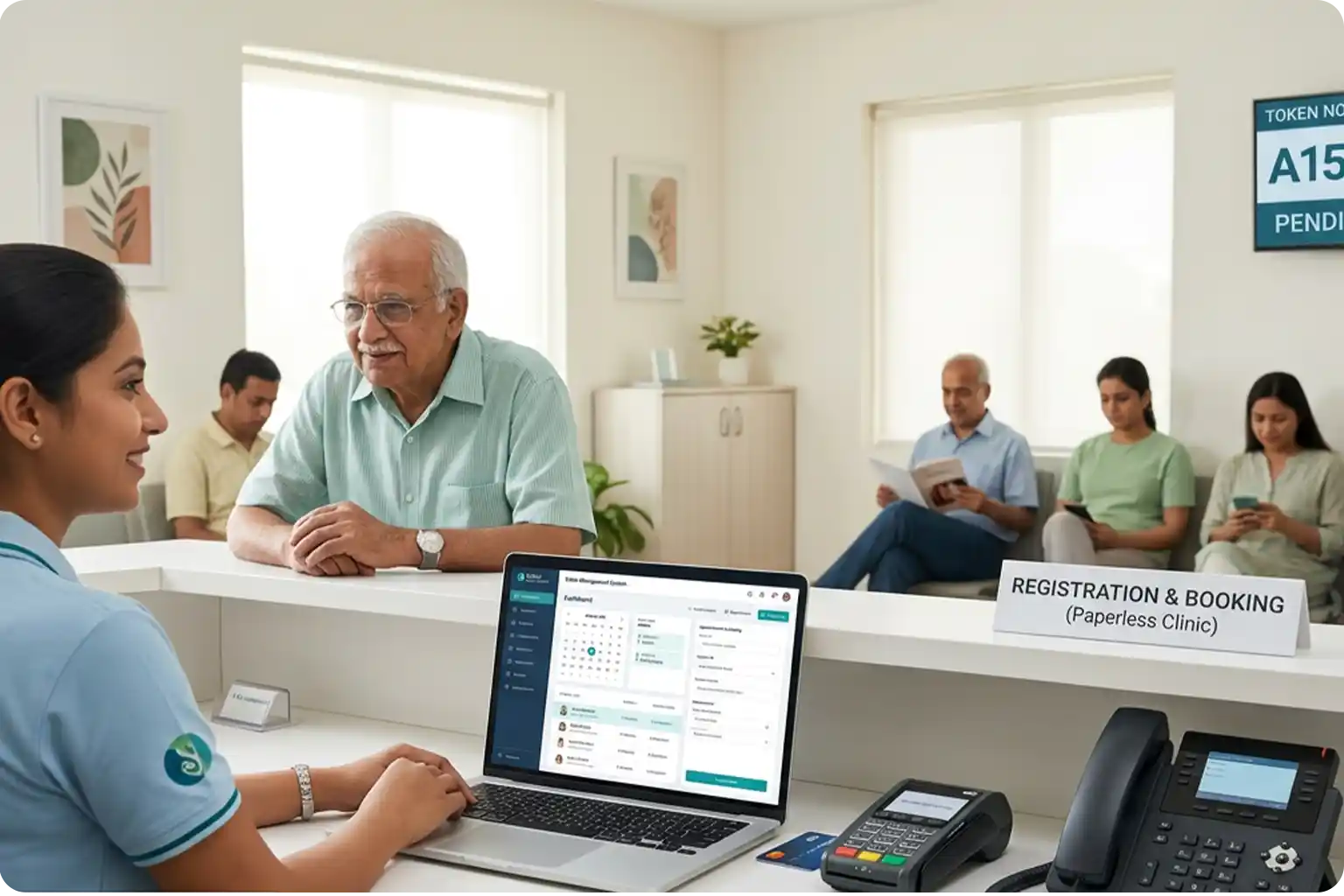
Walk into most Indian clinics on a busy morning and the picture is familiar. A waiting room full of patients. A receptionist managing three things at once — writing in an appointment book, answering the phone, and trying to find last week’s prescription for a patient who is standing at the counter asking for it. The doctor is with a patient but will need the previous visit notes in two minutes. Somewhere in the back, there is a stack of files that nobody has had time to organise since Tuesday.
India has over 6 lakh standalone clinics and polyclinics — the majority of which still operate with paper-based or minimally digitised processes. That gap between the volume of daily clinical work and the tools being used to manage it is exactly what a clinic management system is designed to close.
India’s practice management system market generated USD 522.3 million in 2024 and is expected to reach USD 1,049.0 million by 2030, growing at a CAGR of 12.6%. The growth reflects a straightforward shift — clinics that manage operations digitally see better patient throughput, fewer administrative errors, and significantly less time spent on tasks that a system can handle automatically.
This blog covers what a clinic management system is, what it should do, and how to choose the right one for a clinic in India.
What Is a Clinic Management System?
A clinic management system is a digital platform that manages the day-to-day operations of a medical clinic — patient registration, appointment scheduling, OPD queue management, consultation records, prescriptions, investigations, billing, and follow-up reminders — from one connected system.
The key word is connected. A basic appointment tool manages bookings. A basic billing system generates invoices. A clinic management software that actually makes a difference connects every part of the clinic’s workflow — so when a patient arrives, their history is already visible; when a consultation ends, the prescription and bill are ready in seconds; and when the doctor needs to review a returning patient’s previous notes, everything is there without anyone having to search for it.
India’s clinic management software market shifted decisively to cloud between 2024 and 2026 — 75.5% of new deployments are cloud-based by 2026, up from 58% in 2024. The shift matters practically — cloud-based clinic software means patient records are accessible from any authorised device, backups happen automatically, and the system is always up to date without IT maintenance on the clinic’s side.
What Is the Difference Between a Clinic Management System and a Patient Management System?
The terms are often used interchangeably — and in most practical contexts, they refer to the same thing. A patient management system focuses on the patient-facing side — registration, records, appointments, and follow-ups. A clinic management system covers that same ground and adds the operational side — billing, staff management, OPD flow, and reporting.
In practice, the best patient management software systems in India include both — because running a clinic efficiently requires managing both the patient experience and the operational processes that support it.
Key Features of Clinic Management Software
Not all clinic software is built the same way. Here is what a comprehensive clinic management software in India should include — based on what clinics across different sizes and specialties have found most useful in practice:
- Patient Registration and Digital Records When a patient walks in for the first time, their details go into the system once — name, age, contact, medical background, known allergies, and any existing conditions. From that point, the profile grows with every visit. No paper forms to fill out again. No searching for a file from a previous visit. The record is there, updated, and accessible the moment the patient’s name is entered.
- OPD Appointment and Queue Management Walk-in patients and booked appointments both feed into the same live queue. Reception adds each patient as they arrive. The doctor’s screen reflects the same queue in real time. Everyone, the patient, the receptionist, and the doctor knows exactly where things stand without anyone having to ask. Peak hours become manageable rather than chaotic because the flow is visible and structured from the moment the clinic opens. Our Clinic Management System — iClinics — includes built-in OPD management software that handles the full patient flow from arrival to discharge. For clinics also managing patient queuing at reception, our Queue Management System integrates alongside it.
- Complete Medical History and Visit Records Every consultation recorded — doctor’s notes, diagnosis, investigations ordered, prescriptions given, and follow-up instructions — stored against the patient’s profile. Any authorised doctor or staff member can access the complete history from the first visit to the most recent in seconds. This is the feature that makes the biggest practical difference in day-to-day clinical work. When a patient returns after three months and the doctor can see exactly what was prescribed, what tests were done, and what the findings were — the quality of the follow-up consultation improves significantly.
- Digital Prescriptions Prescriptions are created on screen during the consultation — medicines selected from a structured list, dosage and frequency entered, duration noted. The prescription saves against the patient’s profile automatically. It prints in seconds if needed or gets shared digitally. Three months later when the patient returns, the doctor can see exactly what was prescribed, in what dose, and for how long — without asking the patient to remember.
- Clinic Billing Software Bills generated automatically at the end of each consultation — consultation fees, investigation charges, procedure costs. Receipts generated digitally, printable or sendable by SMS. Payment records stored against the patient’s account. GST applied correctly. No manual calculations, no separate billing registers.
- Investigation and Lab Request Management Investigation requests — blood tests, X-rays, ECGs — raised directly from the consultation screen. Results attached when available. Everything reviewed from the same system at the next visit.
- Follow-Up Reminders Automatic reminders sent to patients before scheduled follow-up appointments. Patients are less likely to miss follow-ups. The appointment calendar stays organised. Staff do not have to manually call every patient on tomorrow’s list.
- Role-Based Access Not everyone in a clinic needs to see everything. Doctors access consultation records and prescriptions for their own patients. The front desk handles appointments and billing without touching clinical notes. Administrators manage reports and system settings without accessing individual patient records. Each person sees what their role requires — and the access log records every interaction for compliance purposes.
How Does OPD Management Software Help With Patient Registration and Waiting Queues?
This is one of the areas where clinic management software makes the most immediate visible difference. Most clinic OPDs in India run on an informal system — patients arrive, give their name to reception, and wait to be called. There is no clear order. Patients with appointments and walk-ins compete for the same slots. And when the doctor runs late, nobody knows how long the wait will actually be.
OPD management software gives this process structure. Patients are registered on arrival and added to a live queue. The order is clear. The estimated wait is visible. Patients can see where they stand without asking reception. And the doctor’s screen shows the queue in real time — so the consultation moves forward without unnecessary gaps between patients.
India’s National Digital Health Mission (ABDM) is creating a unified health ID infrastructure that clinic management software vendors are racing to integrate with, unlocking access to over 500 million registered patient health identifiers. For Indian clinics specifically, this means the right clinic management software in India should be designed with ABDM compatibility in mind — so patient records can eventually connect to the broader national health infrastructure.
Benefits of a Hospital Patient Records Management System
For Doctors
Doctors spend the first few seconds of every consultation looking at the patient’s full history rather than asking them to recall what was prescribed six months ago. Test results from the last visit are right there. The notes from the previous consultation are attached. The consultation itself becomes more focused because the groundwork is already done — the system has everything ready before the doctor even says hello.
For Clinic Staff
Appointment scheduling, queue management, and billing handled from one screen. No switching between paper registers and spreadsheets. No manually calling every patient to remind them of appointments. The administrative workload drops significantly when the system handles routine coordination automatically.
For Clinic Owners and Administrators
Real-time visibility into patient volume, revenue, and clinic performance. Patient data stored securely rather than in physical files. For a clinic with ₹8 lakh monthly revenue, estimated revenue leakage without software is 3-8% — that is ₹24,000 to ₹64,000 per month, or ₹2.88 to 7.68 lakh annually. A properly implemented clinic management system recovers most of that through accurate billing, fewer missed appointments, and better follow-up rates.
Is Clinic Management Software in India Suitable for Small Clinics and Multi-Doctor Practices?
Yes — and the answer is the same for both ends of the size spectrum, for different reasons.
For a single-doctor practice, the value is time. A GP seeing 40 patients a day without a system spends a meaningful portion of that time on administration — finding files, writing prescriptions by hand, explaining billing, calling patients for follow-ups. The right clinic software handles all of that automatically.
For a multi-doctor clinic or hospital patient management system, the value is coordination. Multiple doctors, multiple OPD schedules, shared reception, shared billing — these create complexity that paper-based systems cannot manage reliably. A clinic management system that manages each doctor’s patient queue, prescriptions, and billing independently — from one unified platform — is what makes a multi-doctor practice run without confusion.
The standard tier of clinic management software — serving group practices — held 41.9% market share in 2025 and is growing at 9.4% CAGR. The growth in this segment reflects the reality that mid-sized clinics in India are the fastest adopters of digital management systems right now.
How Can a Hospital Patient Management System Organise Patient Information?
A hospital patient management system — whether for a large hospital or a busy clinic — organises patient information through a structured digital profile that covers every aspect of the patient’s relationship with the facility.
Every visit is recorded. Every prescription is stored. Every investigation is linked to the visit that ordered it. Every bill is attached to the patient’s account. And every interaction — phone call, appointment, reminder sent — is logged against the profile.
The result is that any authorised team member can pull up a patient’s complete history in seconds — not by searching through a cabinet, but by typing a name or phone number. That accessibility changes how clinical decisions get made, how follow-up care is coordinated, and how the administrative side of the clinic operates.
What to Look for When Choosing the Best Clinic Management Software in India
Based on MLAI Solution’s experience implementing clinic management software in India across different clinic types and sizes, these are the factors that matter most in practice:
Does it manage the full patient lifecycle?
Basic appointment tools handle bookings. The best clinic management software covers registration, OPD flow, consultation records, prescriptions, investigations, billing, and follow-ups — all connected in one system.
Is it built for Indian clinical workflows?
GST-compliant billing, OPD queue management, prescription format standards, and ABDM compatibility are not optional for an Indian clinic. They are the baseline.
How quickly can it be implemented?
A system that takes months to implement is not practical for a busy clinic. Most clinics should expect to be operational within a week of starting setup.
Does it work for the clinic’s current size — and its likely future size?
A system that works for a single-doctor practice today should scale to a multi-doctor clinic without requiring a migration to a different platform.
What does support look like?
When something needs adjusting during a busy clinic day, support needs to be reachable and responsive — not a ticket that gets answered in 48 hours.
Explore MLAI Solution’s Clinic Management System — iClinics — built specifically for Indian clinics, with OPD management, digital prescriptions, GST billing, patient records, and follow-up reminders all from one platform.
Frequently Asked Questions
Got questions? We have answers. Here's everything you need to know about MLAI Solution and our products.
Conclusion
India’s clinics are at a turning point. India’s care management solutions market is growing at 16.8% CAGR — outpacing the global rate of 13.6% — and is projected to reach $1,770.4 million by 2031. The growth is being driven by clinics of every size recognising that paper-based management is not a cost-saving measure — it is a cost-generating one.
The clinics that benefit most from implementing a clinic management system are not necessarily the largest. They are the ones where the daily cost of administrative inefficiency time spent finding records, billing errors, missed follow-ups, and the constant friction of a paper-based OPD — has become measurable enough to make the case for something better.
MLAI Solution builds practical software for clinics, hospitals, and healthcare organisations — including our Patient Management System (iClinics), Queue Management System, and Feedback Management System. Book a free demo to see iClinics running in a live clinic environment.