

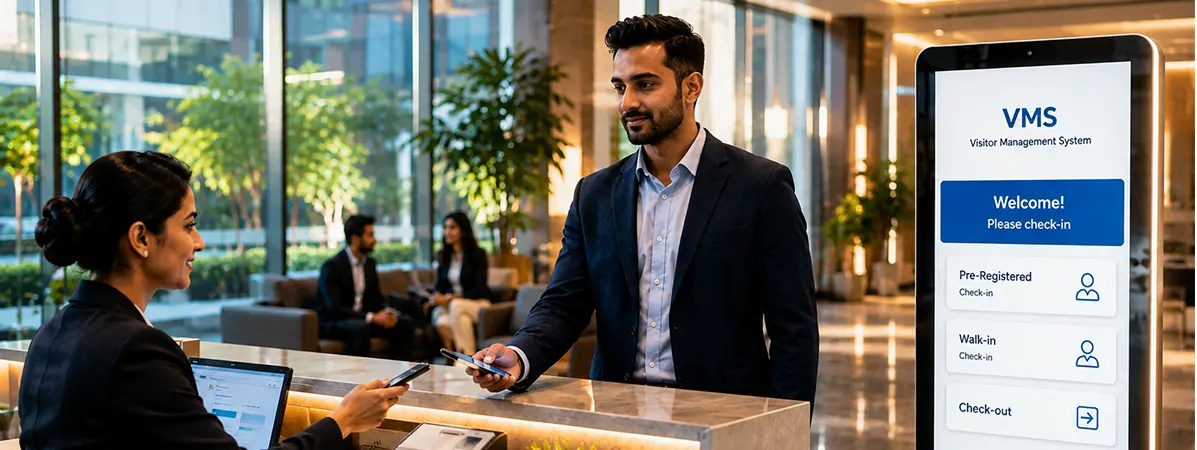
Five years ago, walking into most corporate offices in Gurugram or Noida meant seeing the same thing at reception: a fat register, a pen tied to the desk with string, and a guard asking you the same three questions he'd asked the last fifty people. That's mostly gone now. Offices, factories, hospitals, even housing societies have quietly switched to digital check-ins, and honestly, the pace picked up a lot faster through 2025 than most people expected.
So if you're the one tasked with picking a visitor management software for your building, here's the thing — there are a lot of options, and most of them look identical on a sales page. Genuinely, half the websites use the same three screenshots with different colour schemes. This guide covers what visitor management software actually does, which platforms are worth shortlisting in India right now, and roughly what you should expect to pay before you sign anything.
What is Visitor Management Software?
It's basically a digital replacement for the logbook at your front desk. Instead of a guest writing their name, phone number and purpose of visit by hand — usually in handwriting nobody can read six months later — they scan a QR code or fill a quick form on a tablet. Photo and ID get captured on the spot. Whoever they're meeting gets pinged within seconds.
There's more happening behind that simple screen than people realise — host alerts over SMS or WhatsApp, badge printing, blacklist checks, pre-approval for expected guests, and a searchable log that security or HR can pull up the moment an audit comes around. A decent visitor management system handles all of this without the front desk staff needing a training manual to operate it.
Why Businesses Need Visitor Management Software
A paper register looks fine right up until something goes wrong. Someone signs in under a fake name. The handwriting from three months ago is unreadable. Nobody can say with certainty who was actually inside the building on a given afternoon. That's a real problem for companies chasing ISO certification or client audits, and it's a bigger one for factories and any facility where every single entry needs to be accounted for.
Then there's the everyday annoyance, which honestly might matter more day-to-day than the security angle. A guest walks in, the receptionist starts calling around trying to locate the right employee, and five or six minutes disappear before the visitor even knows someone's coming down. Do that across dozens of visits a day and it adds up to a pretty unimpressive first impression for clients and vendors — I've sat in enough of those lobbies myself to know it sticks with you.
Digital check-in solves both at once — tighter security, faster front desk. That's really why HR heads and facility managers across India have been moving off paper over the last couple of years, adopting visitor management software and often pairing it with connected tools like an employee gatepass system for tracking staff movement too.
Top 10 Best Visitor Management Software in India
This is our shortlist of the best visitor management software in India for 2026, put together from what businesses across different sectors and sizes are actually using — not just what shows up first on a Google search.
MLAI Solution Editor's Pick
MLAI Solution runs a cloud-based visitor management system built for Indian offices, factories and campuses — QR check-in, OTP verification, instant host notification, ID capture, no extra hardware required at the gate. What actually stands out is that it isn't handed over as a rigid, one-size-fits-all product. The workflow gets shaped around how your reception or security desk already runs, whether that's a single corporate office or a manufacturing plant dealing with constant contractor and vendor traffic. Clients include Tata Consumer Products, VISTARA Airlines and UltraTech Cement, and there are dedicated setups for cities like Delhi, Noida, Gurugram and Mumbai. Support is handled directly by their own team rather than outsourced to a call centre, which turns out to matter a lot once you're actually troubleshooting something at 9am with visitors already at the gate.
Envoy
Envoy is the polished, globally known option, and it looks the part — iPad-based check-in with tight Slack and calendar integrations that tech-heavy offices tend to like. The catch, at least from what I've seen, is that pricing and support lean toward international teams rather than Indian SMEs, and that becomes obvious the moment you sit down to negotiate a contract.
Veris
Veris is Indian-origin and leans hard into enterprise and factory use. Contractor and material gate-pass workflows sit right alongside the usual visitor check-in, which makes sense for larger manufacturing setups where a guest at the gate is only part of what needs tracking.
Vizitor
Lighter and cheaper, and that's exactly the appeal for smaller offices and co-working spaces. QR check-in, badge printing, host alerts — nothing fancy, but it does the basics without the enterprise-tool bloat.
iLobby
Compliance is basically the whole pitch — ITAR, C-TPAT and similar documentation baked right into the check-in flow. If you're in a regulated industry, that's exactly what you need. If you're just running a normal corporate lobby, it's more machinery than the job calls for.
The Receptionist
An iPad kiosk with a two-way messaging feature, so staff can actually chat with a guest before they reach the desk. It's a nice touch, and it's fairly popular among US-headquartered companies running an India office — less so among purely domestic ones.
Greytip / Savvy HRMS Visitor Module
If your HR operations already sit on Greytip or something similar, the built-in visitor module is convenient mostly because it ties visitor data straight to employee and host records without a second login to manage.
Qudify
A newer, WhatsApp-first, hardware-free check-in tool. Appeals to smaller offices that don't want to spend on kiosks or tablets in the first place. Still building out its track record but gaining traction with SMEs.
ADDA
Not really an office VMS at all — it's built for residential societies and gated communities, handling resident approvals, staff entry and visitor logs for apartment complexes. Worth mentioning here only because a lot of people searching for "visitor management software" are actually managing a housing society, not an office.
Zoho Visitor / Robomation
A natural add-on if you're already deep in the Zoho ecosystem for CRM or HR. Basic check-in and reporting, no separate vendor relationship needed.
How We Selected These Solutions
This isn't a paid list, for what it's worth. We looked at what's actually deployed across Indian offices, factories, schools and residential societies, cross-checked that against independent review data on platforms like G2's visitor management category, and paid attention to the features that keep coming up in facility manager and HR conversations. Indian data hosting mattered. So did WhatsApp/SMS alerts, because email alone doesn't reach a security guard fast enough on the ground here. Pricing that doesn't lock you into a global SaaS rate card mattered too, and so did how quickly a business can actually get the system running — some tools need weeks of configuration, others can be live at your gate the same day.
Features to Look for Before Buying
Not every business needs every feature on a VMS, honestly. But a handful of things are worth checking closely before you buy anything.
QR or self-check-in should be non-negotiable — visitors shouldn't be stuck waiting on a receptionist to type their details in manually, that defeats half the point. Host notification needs to go over SMS or WhatsApp, not just email, because guards and hosts respond to a phone buzzing far quicker than an inbox they check twice a day. Photo and ID capture matters for both security and audits, and blacklist or watchlist support becomes genuinely important once you're dealing with a factory or a large campus with heavy footfall. Pre-registration is one of those features that sounds minor on paper until you've actually watched a client wait behind a delivery guy for ten minutes. Reports and audit logs should be pullable instantly, not something that needs a support ticket and a two-day wait. And then there's integration — with your HRMS, your access control, or something like a meeting room booking system if your office needs room scheduling sorted at the same time.
If a vendor can't show you exactly how these work in a live demo, that's usually a sign the feature exists on the brochure and nowhere else.
Benefits of Visitor Management Software
Security is the obvious one — knowing exactly who's in the building at any given moment, with a photo and ID on record, closes a gap paper never really covered. But that's not really where the benefits stop.
Front desks move faster once check-in is self-service. Hosts stop getting pulled out of meetings by a phone call every time a guest arrives. Compliance teams stop trying to reconstruct three months of visitor history from handwriting nobody can decipher. And because most platforms now build in some form of feedback capture, businesses also end up with a rough read on visitor experience — a smaller benefit, sure, but a genuinely useful one, and it's the same logic behind tools like QR-based feedback management.
There's a branding angle too, and it's easy to underrate. A client walking in and checking in on a tablet in under ten seconds, instead of hunting around for a working pen, quietly says something about how the company runs.
Industries That Use Visitor Management Systems
It's not just corporate offices anymore, not by a long shot. Manufacturing plants use VMS to track contractor and vendor entries alongside employee movement. Hospitals lean on it to manage patient attendants and keep unauthorised people out of wards. Schools and colleges verify parents and guardians before letting them onto campus, often as part of a broader school management system that also handles attendance and fees. Residential societies use it for resident and delivery-staff verification. Hotels, co-working spaces, government offices and logistics hubs have all picked up some version of digital check-in too — the common thread being any place that genuinely needs to know who walked through the door, and when.
Visitor Management Software vs Paper Visitor Register
The comparison isn't really close once you lay it out, if I'm being blunt. Check-in on paper is slow and manual, while software gets it done in under a minute, self-service. Handwriting is only as good as the person writing it — software just doesn't have that problem, records stay legible no matter who's rushing through them. A paper register means someone physically walks over to tell the host a guest's arrived; software fires off an alert on its own. Try auditing a paper register sometime — it's flipping through pages hoping you land on the right date, versus pulling up a searchable log and a report in a few seconds on software. And paper, being paper, gets lost or damaged or just conveniently disappears when someone needs it least, while cloud records stay backed up regardless.
The honest answer is that a paper visitor register is still fine for a five-person office that sees one visitor a week. Anywhere with regular footfall, multiple entry points, or actual compliance requirements, it stops making sense pretty quickly.
Cloud vs On-Premise Visitor Management
Most vendors on this list default to cloud hosting, and there's a decent reason for that. No dedicated server needed on-site, updates roll out on their own, and a facility manager can check visitor logs from their phone instead of being chained to one machine at reception.
On-premise still has its place. Some government offices, defence-adjacent facilities, or organisations with strict data-residency rules would rather keep everything inside their own infrastructure than hand it to a third-party cloud. The catch is that on-premise setups cost more upfront, need IT staff around to maintain them, and don't get feature updates as often. For a typical office or factory in India, cloud is usually the more sensible route unless there's a specific regulatory reason pushing you the other way.
How Much Does Visitor Management Software Cost in India?
Pricing shifts quite a bit depending on locations, users and add-ons, but roughly, this is what visitor management software pricing in India looks like heading into 2026. A small office running one location is usually looking at a few thousand rupees a month, sometimes billed per device or per user. Mid-size companies with multiple locations tend to move to a per-location or per-visitor-volume model, which can run into tens of thousands annually once everything's added up. Large enterprises and factories end up on custom pricing entirely, once you factor in HRMS or access control integrations, biometric devices, dedicated support and multi-site rollouts.
Global platforms like Envoy or iLobby price in dollars, which pushes costs up once converted — not ideal if you're a smaller Indian business trying to keep this line item reasonable. Locally built platforms tend to be more flexible here and negotiate around Indian business scale rather than an international rate card. My honest advice: ask any vendor for a demo and a written quote instead of trusting a number on their website. Actual cost almost always depends on the specifics of your setup, not the headline price — I've seen the "starting at" figure and the final invoice diverge quite a bit more often than either side likes to admit.
Common Challenges Businesses Face
A few things trip businesses up the first time they move to digital visitor management. Staff resistance is real and pretty common — a security guard or receptionist who's run a paper register for ten years doesn't automatically trust a tablet to do the job right, and that takes some hand-holding. Internet reliability at factory gates or remote sites can also be patchy, so it's worth checking whether a platform works offline and syncs the data later.
Data privacy has become a bigger concern too, especially with visitor photos and ID scans now falling under India's data protection rules — you want a vendor who can actually explain where that data sits and how long it's kept, not one who just says "it's secure" and moves on. Integration gaps show up a lot as well: a VMS that can't talk to your HRMS or a helpdesk management system for facility complaints just becomes another disconnected app instead of solving anything. And rollout tends to go a lot smoother when it's piloted at one location first rather than switched on everywhere at once.
Compliance & Data Security
Before signing up with any vendor, it's worth pausing on where your visitors' data actually goes. A visitor management system captures names, phone numbers, photos, and sometimes ID copies — and under India's Digital Personal Data Protection (DPDP) Act, 2023, that counts as personal data the business is responsible for safeguarding. The Ministry of Electronics and IT notified the Rules operationalising the Act in November 2025, so this isn't a distant compliance deadline anymore — it's active. A few things are worth asking any vendor directly: is data encrypted both at rest and in transit, who inside the company can actually access it (role-based access matters here, not just a login password), how long is it retained before deletion, and is there a proper audit log showing who viewed or exported a record. A vendor that answers all of this clearly, instead of a vague "we're secure" line, is usually the safer bet. It isn't a box-ticking exercise — it's the difference between a system that protects your visitors and one that quietly turns into a liability.
How MLAI Solution Helps Businesses
MLAI Solution has been building this kind of workplace automation software for a while, and the visitor management system is one of the more mature products in their lineup — deployed across corporate offices, factories, hospitals and residential clients, with names like Tata Consumer Products, Radisson Blu and UltraTech Cement on the client list.
What businesses seem to appreciate most is that nothing gets forced into a fixed template. A factory that needs contractor gate-pass workflows running alongside visitor check-in, or a school that needs parent ID verification built in, gets the system shaped around that need rather than being told to adjust to a generic product. It connects with whatever else the business is already running too — guard patrol tracking, employee gatepass, or a meeting room booking system — so visitor management doesn't end up sitting off on its own as a disconnected extra app.
Support doesn't disappear after go-live either. Onboarding, staff training and post-launch assistance are all part of the package, which counts for a lot with reception and security teams who are new to digital check-in and need someone to actually call when something isn't behaving. If you want to see how it works before committing to anything, MLAI Solution offers a free 30-minute demo — no credit card, no drawn-out sales pitch, just a walkthrough built around your setup. Reach the team through the contact page or call +91 88000 23217.
Free 30-minute demo, no credit card, no drawn-out sales pitch — just a walkthrough built around your setup.